
MHD Flasher is the reason a lot of BMW owners tune their own cars in a driveway instead of booking dyno time. It's a phone app that writes a full remap to the factory DME over the OBD port, and it's genuinely straightforward once you understand the sequence. Where people run into trouble is everything that happens before the flash button: picking the right app, discovering their DME is locked, buying a licence that turns out to be tied to someone else's VIN, or flashing a car with a weak battery.
This walks through the whole process in order.
Step 1: Confirm which app your engine uses
MHD isn't one app. It's a family of them, split by engine and chassis generation: E-Series N54, E-Series N55, F-Series N55, F-Series S55, F-Series N13, F+G-Series B58, F+G-Series S58, and S63. Licences are not transferable between them.
The B58 app also covers the Toyota Supra A90, which shares the engine and the DME architecture. If you're buying a licence, buy it for your engine code, not your model badge, an F30 can be an N20, N26, N55 or B58 depending on year and market, and only the engine code tells you which app applies.
Step 2: Find out whether your DME is locked, this is the step people skip
On newer engines, BMW locks the DME against OBD writing. If yours is locked, no licence will let you flash until it's unlocked, and this catches people out after they've already paid.
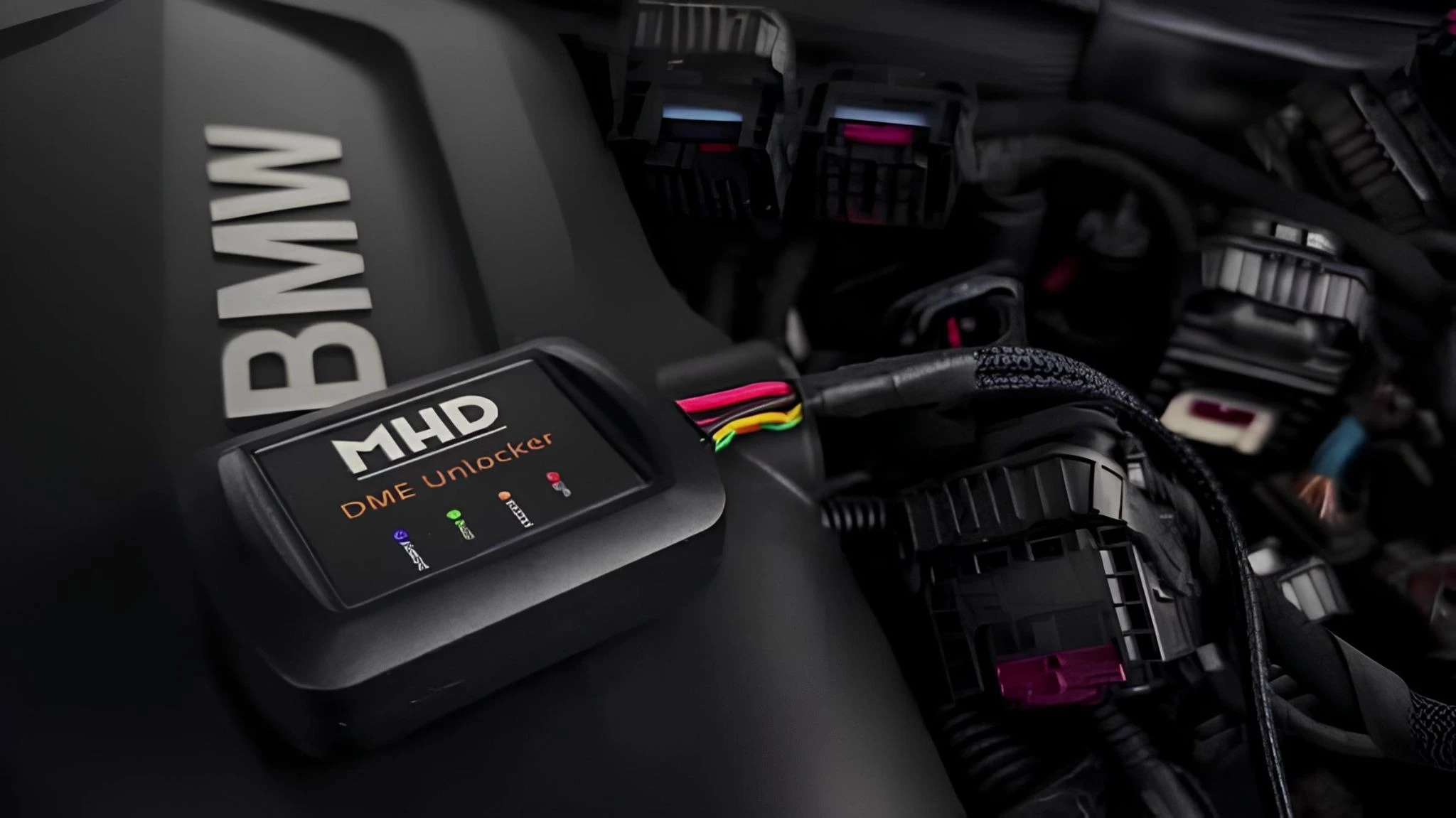
The rough picture: N54, N55 and S55 cars flash over OBD without any unlock. B58, S58 and S63 (F90) cars have locked DMEs, and how you deal with that depends on the DME's production date. Units built before June 2020 can be unlocked at home using MHD's own Unlocker device, which plugs in with a supplied harness and runs from the same app. DMEs produced from June 2020 onwards can't be unlocked that way, those need a bench service, meaning the DME comes out of the car and goes to a specialist.
One detail that causes a lot of confusion: the DME's production date is not the car's build date. A 2020 car can have a 2021 DME and vice versa. Check the date on the module itself, or ask a shop to read it, before buying anything.
Step 3: Get the hardware
MHD flashes over WiFi, not Bluetooth, and the app expects the correct adapter. The MHD Universal WiFi adapter plugs into the OBD-II port and creates its own WiFi network that your phone joins, that's how the flash, the datalogging and the fault-code functions all communicate. TunePoint Europe: https://tunepoint.eu/collections/brands_mhd is an official MHD dealer in Europe, which is worth caring about for two reasons: you get EU shipping and EU consumer rights instead of an import, and you're buying through a channel MHD controls rather than a marketplace listing where cloned adapters circulate freely.
Generic ELM327-type dongles are a common false economy here. Some connect and appear to work for reading codes, then drop the connection mid-flash, which turns a five-minute job into a recovery procedure.
You'll also want a battery charger or maintainer capable of holding voltage steady during the flash. Not strictly mandatory on a healthy battery, but it's cheap insurance for the one part of the process where an interruption actually matters.
Step 4: Choose the right licence
MHD's licensing is modular, which confuses first-time buyers because "buying MHD" can mean several different things:
- Flasher licence: the ability to write to the DME. This is the core purchase. It includes stock-power flashing and a long list of flash options (exhaust burble settings, cold-start noise reduction, top-speed limiter removal, sport cooling modes, kickdown deactivation, and so on) but no performance maps.
- Map packs: the off-the-shelf maps themselves, sold by stage and fuel type. On N54 these come from Wedge Performance; on B58 from PureBoost.
- Monitor licence: datalogging and live gauges, up to eight configurable channels.
- Super licence: everything bundled: flasher, monitor and the map packs.
If you're planning anything beyond a single stage-one map, the Super licence usually works out cheaper than assembling the same functionality piece by piece. If you already know you're going to a custom tuner, the Flasher licence plus Monitor is often the right combination, since your tuner supplies the maps.
Buy from MHD directly or from a dealer listed on MHD's site. Licences are bound to a single VIN, which is exactly why second-hand licences sold on forums and in Facebook groups are a persistent problem, the discount is real, the access frequently isn't, and once it's revoked there's no recourse because you were never MHD's customer.
Step 5: Prepare the car
The flash itself is the easy part. What determines whether it goes well:
- Battery. Healthy and on a charger. Voltage sag during a write is the most common cause of a failed flash.
- No pending faults. Read and clear codes first. Flashing over an existing misfire or sensor fault means you won't know afterwards whether the tune caused it.
- Maintenance done. Spark plugs in good condition, no boost leaks, no oil leaks. A tune exposes marginal ignition components immediately.
- Correct fuel in the tank. Every MHD map is written for a specific octane. Have the fuel the map expects in the car before you flash, not after.
- Remove other tuning devices. Piggyback modules and other flash tools need to come off, and if the car was previously flashed with another tool, return it to stock through that tool first.
- Phone ready. Charged, and set so it won't sleep or take a call mid-flash.
Do this in a garage or driveway, not a car park an hour from home.
Step 6: The initial install
Install the app for your engine, enter your VIN, and redeem the licence against it. Then plug in the adapter, connect your phone to the adapter's WiFi network, and follow the app's connection check.
The first write is longer than every subsequent one because MHD has to install its own bootloader. On the F and G series apps the initial install is quick, MHD quotes around three and a half minutes with their adapter, while the older N54 E-Series app takes around fifteen. After that, switching between maps takes seconds rather than minutes, which is the whole point of the platform.
During the write: ignition on, engine off, don't touch anything, don't open a door if the app tells you not to. If the flash fails partway, don't panic and don't disconnect, the app has a recovery path, and the usual cause is voltage or a dropped WiFi connection rather than anything permanent. Note the percentage at which it failed, because that's the first thing support will ask.
You don't need to back up your stock file first. MHD keeps the ability to return the car to the factory calibration at any point.
Step 7: Choosing your first map
Resist the urge to start at the top. Map selection is dictated by hardware, not ambition:
- Stage 1 is for stock cars. On B58 that's roughly 420 hp, and higher on the Gen 2 engine. It's also the correct choice if your car has a petrol particulate filter.
- Stage 2 assumes a high-flow downpipe and, on B58 maps, no GPF fitted. Around 470 hp, more on B58TU1.
- Stage 2+ and above assume upgraded fuelling. On N55, the higher maps explicitly require an upgraded HPFP alongside the intercooler and downpipe.
- Ethanol maps require you to actually run that blend, consistently, in every tank.
Pick the map that matches what's bolted to the car right now. A Stage 2 map on a stock exhaust and a heat-soaking intercooler doesn't give you Stage 2 power, it gives you timing corrections.
Before you flash a map, be honest about what's legal where you drive. Removing a particulate filter, or fitting a catless downpipe, will fail a technical inspection in most European markets and can affect an insurance claim. Plenty of MHD's flash options are inspection-neutral; the emissions-related hardware isn't.
Step 8: Log the car, this is what separates a good tune from a lucky one
Flashing and never looking at data is the most common mistake among first-time users. The Monitor licence exists for exactly this reason.
Log a few third-gear pulls immediately after your first map. The four things to watch: timing corrections (per cylinder, where available), knock events, boost target versus actual, and fuel pressure under load. What you're looking for is stability, corrections should be small and consistent, boost should meet target, and fuel pressure shouldn't fall away at the top of the rev range.
If any of those look wrong, go back to stock and diagnose before driving the car hard. A repeat log after the seasons change or after you switch fuel supplier is also worth the ten minutes; the same map behaves differently at 5°C and 35°C.
Step 9: Living with it
Two practical habits. First, return the car to stock before dealer service or before selling, it takes a minute, and MHD keeps the option available permanently. Second, treat the maintenance schedule as shorter than stock: more heat and more load means oil intervals that were fine before are now too long, and plugs are a consumable rather than a fit-and-forget item.
And on automatic cars, remember the gearbox exists. Torque above stock will slip the 8HP's clutch packs unless the transmission side is addressed too, MHD's newer B58 and S58 apps can log transmission data in parallel with the engine, which makes it much easier to tell whether a problem is mechanical or calibration.