
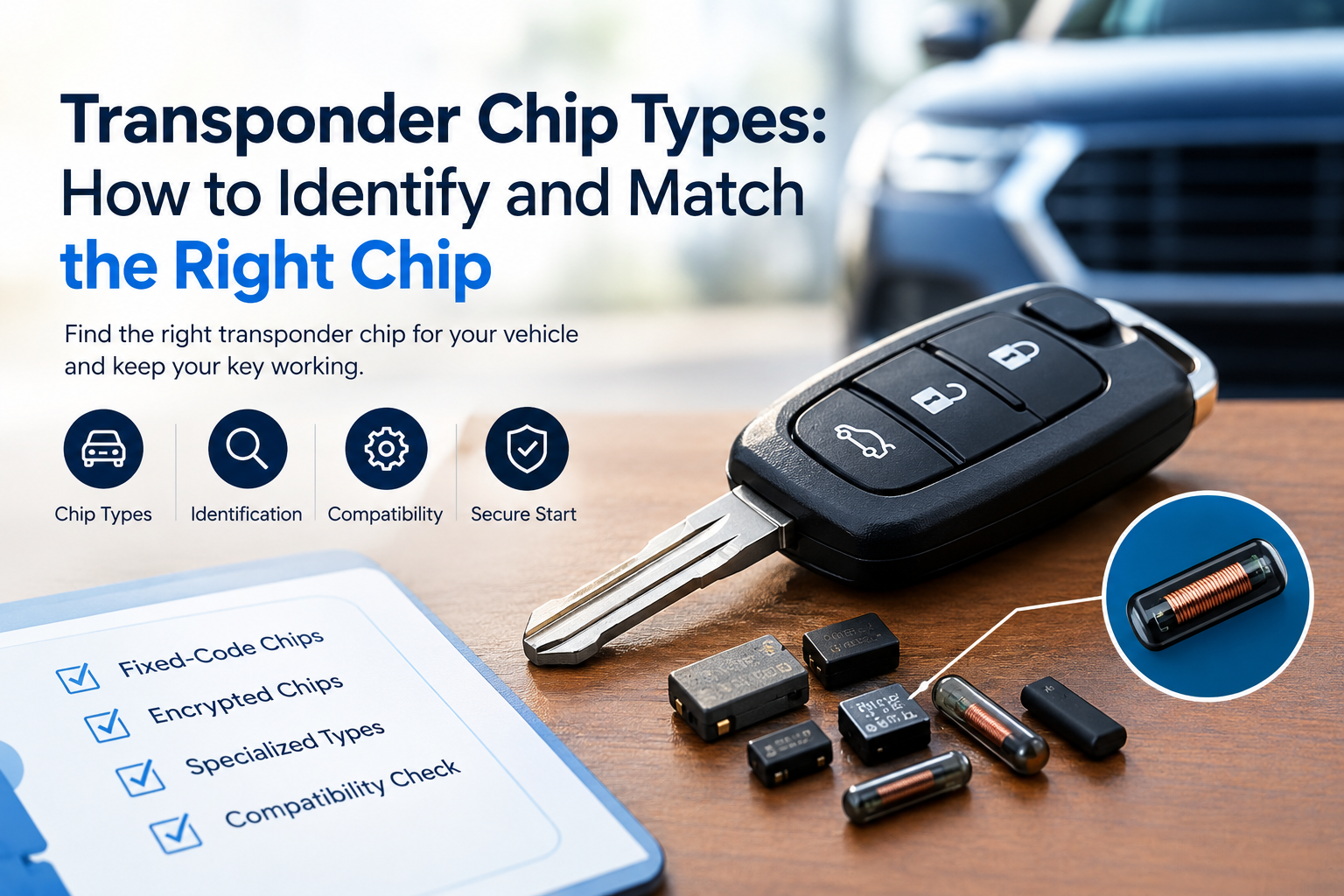
A replacement car key can slide into the ignition, turn smoothly, and still leave the engine silent. The metal blade did its job. The trouble sits in a tiny electronic part you cannot see. Car key chips talk to the vehicle's security system, and that system decides whether the key is allowed to start the engine. Not every chip works with every vehicle, and a wrong pick gives you a key that turns but goes no further. So what exactly is hiding inside that plastic head, and what is it doing there?
What Is a Transponder Chip?
A transponder chip is a small electronic component built into certain car keys. Its one job is to give the vehicle a way to recognize an authorized key.
Sometimes it sits inside the plastic head of a standard key. In other designs, it lives within a remote head key or a smart key assembly, out of sight. It usually does not rely on the battery in the remote buttons, because the car powers it wirelessly when the key is close. Picture it as an ID card for the key, not a button or a battery.
How Transponder Chips Work in Automotive Keys
Here is the short version of what happens every time you start the car:
- You insert the key, or bring a compatible smart key into the cabin.
- The vehicle's reader sends out a wireless signal, and the chip wakes up.
- The chip answers with its identification data.
- The security system compares that answer with what it has stored.
- If they match, the engine is allowed to start. If not, it stays disabled.
Older ignition keys depend on a reader around the ignition cylinder, while smart key systems check from inside the cabin. The driver sees the same result either way, but the hardware behind it differs, and that difference is one reason manufacturers use more than one chip family.
Common Types of Automotive Transponder Chips
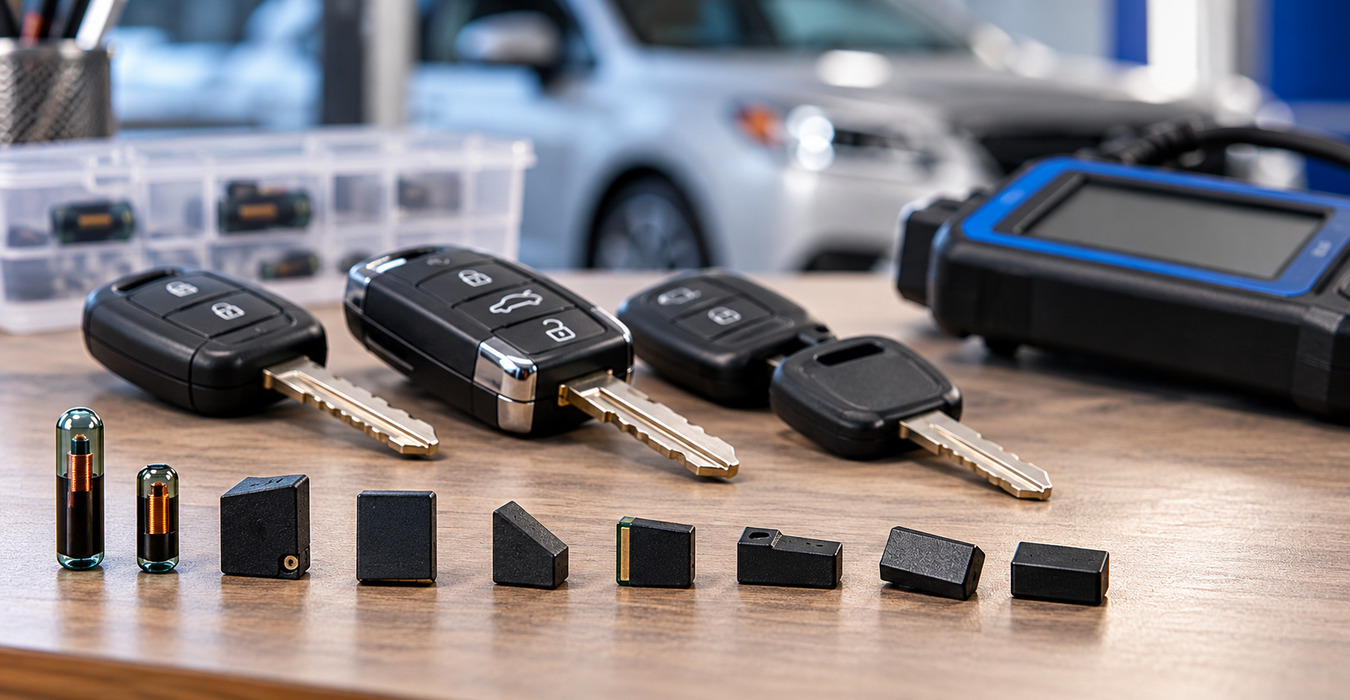
Chips are sorted into families, and manufacturers choose different ones depending on the vehicle and the era. Shopping for automotive transponder chips gets much easier once you know two things: how a chip stores its identity, and what the family is called.
Fixed-Code and Clonable Chips
Fixed-code chips are the easiest to picture. Each one carries a single, unchanging identification value, and the car simply checks for it. "Clonable" is a different kind of label. It describes what supported equipment may be able to do, not a chip family of its own.
- Some fixed-code chips can be duplicated with suitable equipment.
- Certain encrypted chips can be cloned too, using specialized tools.
- Support depends on the chip family and the specific device in use.
- Cloning a chip and programming a key to a vehicle are two different tasks.
Specialized Transponder Chip Types
A handful of names show up again and again:
- ID46 and ID47: common encrypted families, often tied to particular vehicle lines.
- ID48: a Megamos family with its own handling rules.
- Texas 4C and 4D: 4C is a fixed-code chip, while 4D is an encrypted family with several variants.
- Toyota H chips: used in certain Toyota applications and sold as their ownproduct type.
Treat a family name as a clue, not a verdict. Two keys with the same chip family can still suit different vehicles.
How to Identify a Transponder Chip
You cannot spot a chip by looking at the key, so identification takes a few deliberate steps:
- Start with the original working key, if you still have it.
- Check the key for a part number or any identification markings.
- Write down the make, model, model year, and any configuration details.
- Ask an automotive locksmith to read the chip with a suitable transponder reader.
- Compare what the reader shows with reliable product specifications.
- Find out whether the replacement needs chip preparation or a particular programming method.
Appearance alone is never a dependable guide. Two chips that look alike under the plastic can belong to entirely different families. A professional reader earns its place here because supported models can recognize a range of fixed-code and encrypted chips, which saves you from guessing based on the key's shape or brand.
How to Check Transponder Chip Compatibility
Knowing the chip ID is only half the job. Real transponder chip compatibility comes down to this list:
- Confirm the exact vehicle application.
- Compare the required chip ID or supported chip family.
- Check the original equipment or replacement part number.
- See whether the chip is supplied blank, preconfigured, or prepared for a specific application.
- Find out whether it supports the cloning or programming method you plan to use.
- Make sure your programming equipment supports that vehicle and chip combination.
- Ask a professional when the specifications are incomplete or contradict each other.
One point trips up many buyers: the right chip alone does not make a finished key ready to drive. Physical fit, chip match, and vehicle authorization are three separate hurdles, and a key has to clear all of them.
Transponder Chips vs. Transponder Keys: What's the Difference?
A transponder chip is the electronic component. A transponder key is the complete, assembled key that carries it.
Think of a house key with a tiny badge hidden inside. The metal blade works the mechanical lock, while the chip takes part in the start authorization. In some keys, a locksmith can replace or prepare the chip on its own. In others, the electronics are built into one unit, so the whole assembly has to be swapped. Which case applies depends on the key design and the vehicle, so check before you order.
Common Transponder Chip Selection Mistakes
Most wrong orders start with an assumption that sounds reasonable. Here are the usual ones and what tends to follow:
What people assume | What actually happens |
A chip that looks the same is the same | The key fits the ignition, but the engine will not start |
One manufacturer uses one chip | Different models and years can use different families |
A clonable chip is ready to drive | Copying a chip does not finish the job for the vehicle |
Model year does not matter | A chip that suits one year may fail on the next |
A universal chip fits everything | It only works within its supported applications |
A cut blade means the key is done | Cutting handles the mechanical side and nothing else |
Each of these costs time and money, and each is avoidable with a few minutes of checking.
Choosing the Right Transponder Chip
Looks tell you very little here. What decides whether a key starts the car is the chip's identity and a confirmed match with the vehicle's security requirements. When the specs seem incomplete or contradict each other, ask a professional locksmith before buying, and keep the original key close for comparison. Explore the availabletransponder chip options at Transponder Island, and compare the listed specifications before you select a replacement.
FAQs
What is a transponder chip?
It's a small electronic part built into certain car keys. It gives the vehicle a way to recognize an authorized key, so the engine only starts for keys the car trusts.
How do automotive transponder chips work?
When you insert or bring in the key, the car's reader wakes the chip. The chip sends back its ID, the car checks it, and a match lets the engine start.
What are the different types of transponder chips?
Chips fall into fixed-code and encrypted groups. Names you'll hear most are ID46, ID47, ID48, Texas 4C and 4D, plus Toyota H chips. Cloning support varies by family.
How do I identify a transponder chip?
Start with the original key and any part number on it. A locksmith can then read the chip family with a transponder reader, and you can compare it with product specs.
What is the difference between a transponder chip and a transponder key?
The chip is the electronic part that talks to the car. The transponder key is the whole assembled key, blade and electronics together, with that chip inside.