
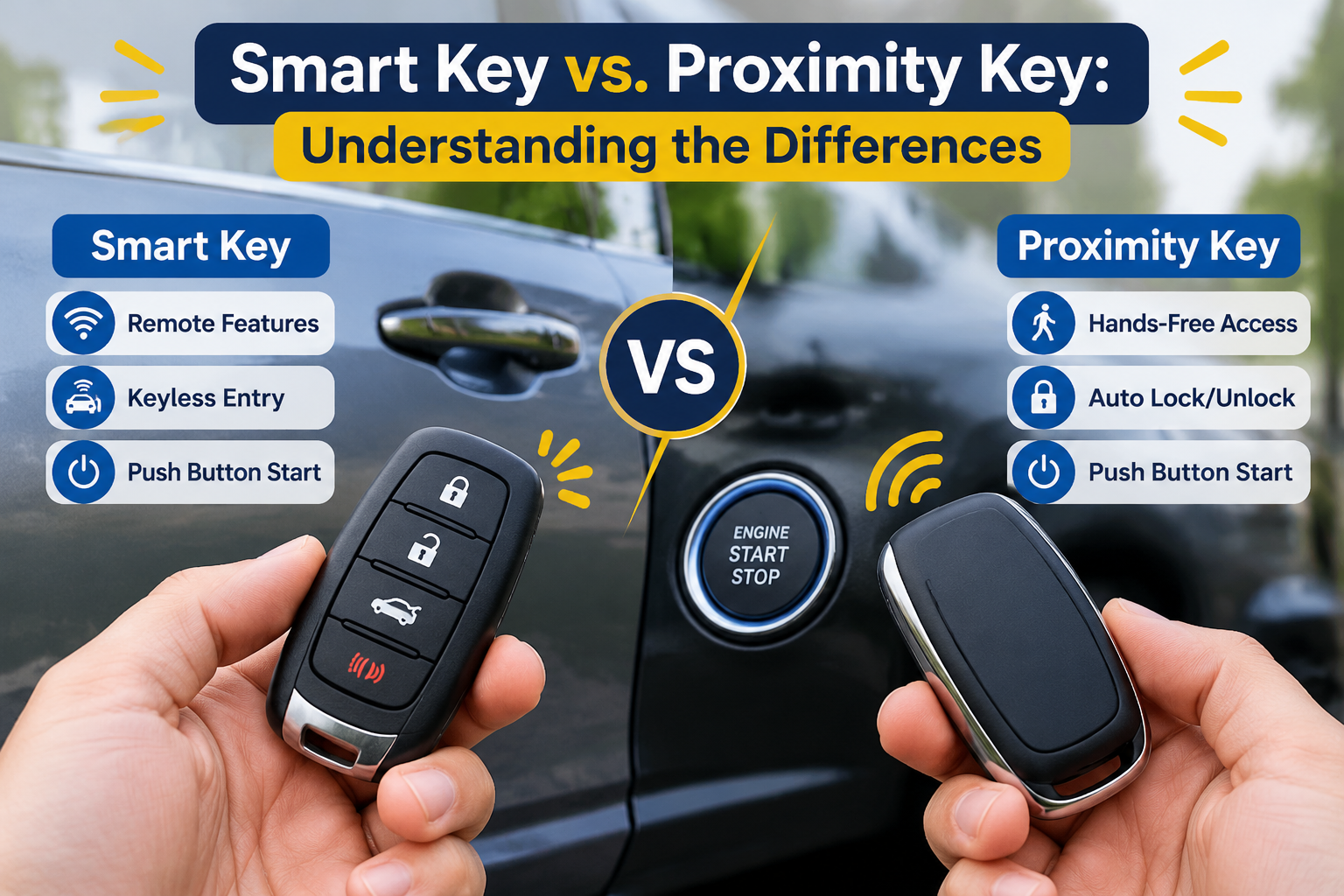
Ask ten drivers what sets a smart key apart from a proximity key and you'll hear ten confident answers, most of them different. The truth is simpler than the debate. The two are mostly one idea wearing two labels, and the real gaps sit in naming, extras and how the key feels in daily use. Let's sort out which is which, so the next time someone says "proximity" or "smart" you know exactly what's in your pocket.
What Is a Smart Key?
A smart key is the fob you never have to dig out. It stays in a pocket or bag, and the car simply recognizes it when you're nearby. Plenty of carmakers use the name, and some attach it to a fuller bundle of features: remote start from a distance, driver seat memory, a trunk that opens on a button hold. That's why "smart" can sound like the upgraded version, even though the basic trick matches the one in the next section. Think of the name as a badge, and the features as what's actually behind it.
What Is a Proximity Key?
Now meet the second name. A proximity key gets its label from what it does: it only needs to be close, roughly within arm's reach of the car, to do its job. No pressing, no inserting, no fumbling. You'll hear this name a lot in repair shops, parts catalogs and owner's manuals, where plain descriptions win over brand names. Many carmakers also have their own versions, with names like intelligent key or comfort access, and they all describe the same hands-free habit. So when two people argue over the label, they're usually describing one key from two angles.
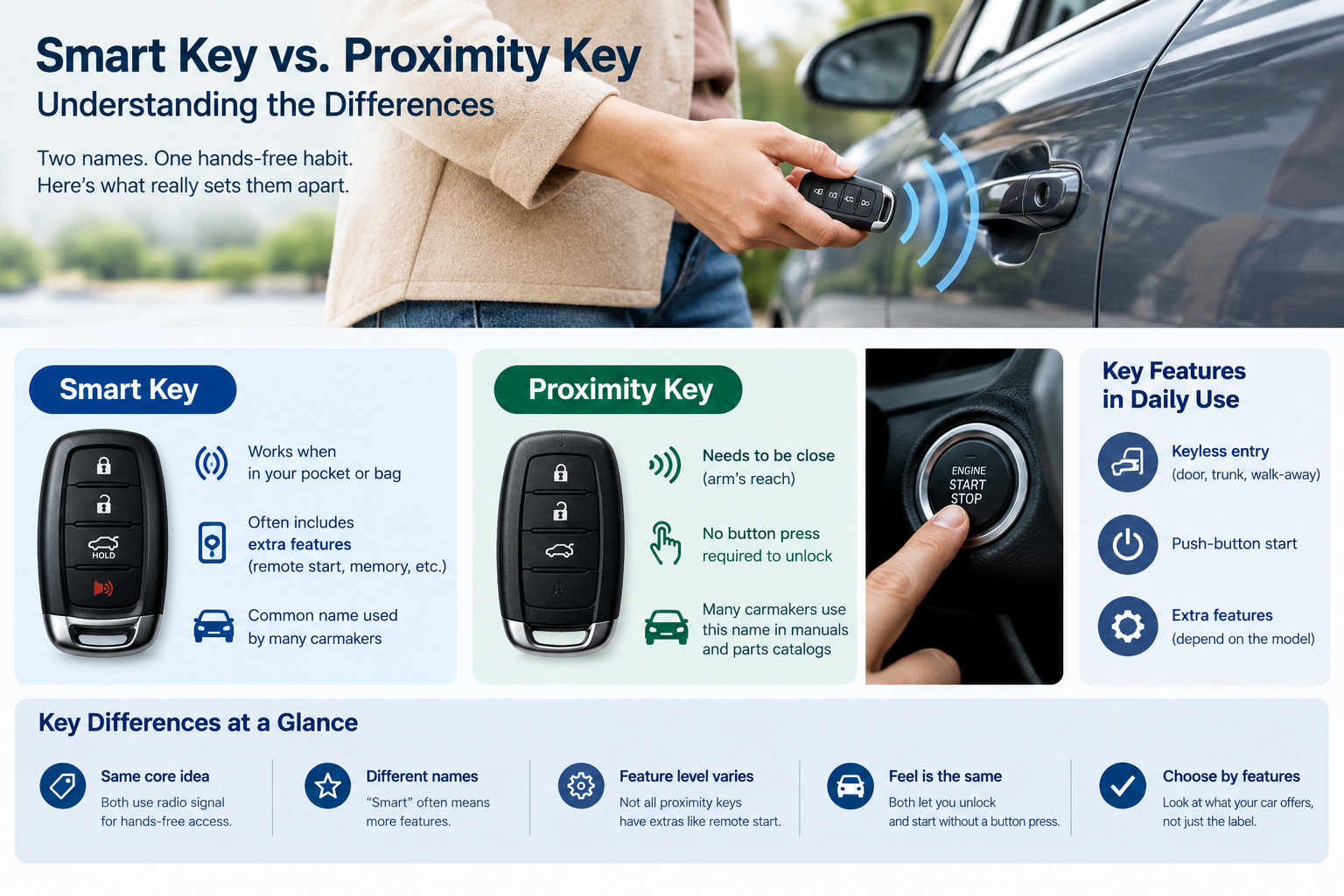 Smart Key vs. Proximity Key: Key Differences
If the idea is shared, where does the gap come from? Mostly from how each system feels in use and which extras ride along. Two moments show it best: the walk up to the door and the moment you sit down to drive.
Keyless Entry and Vehicle Access
A keyless entry system sounds like one thing, but here's how it plays out day to day:
- At the door: touch the handle and it opens. No button, no digging.
- Walking away: step off and the car locks, or tap a small spot on the handle.
- The trunk: many models open it with a button on the lid or a foot swipe under the bumper.
- Extras: systems sold as "smart" often add perks like opening only the door you touch or welcome lights. A basic proximity setup may skip them.
Push-Button Start and Key Communication
Inside the car, the story moves from doors to ignition. Sit down, press the brake and push the start button. That's it. There's no slot and no twist, and the key can stay in your pocket for the whole drive. The car keeps checking that the key is somewhere inside, and if it isn't, it warns you rather than leaving you stranded mid-journey. A few cars will keep running if the key leaves the cabin, then refuse to start again. That small check is the real daily difference: not which name is on the box, but how forgiving your car is when the key wanders off.
How Smart and Proximity Key Systems Work
Picture a walk from the front door to the driveway. Here's what the car and key are doing the whole way:
- You approach. The car sends out a short ping every so often, looking for its key.
- The key answers. Your proximity key fob hears the ping and replies with a secret code. The code changes each time, so a recorded one is worthless.
- The car checks. If the code is right, the doors are allowed to open when you touch the handle.
- You sit and press. Inside, the car pings again to confirm the key is in the cabin before it lets the engine start.
- You walk away. The pings stop getting an answer, and the car locks.
How to Identify a Smart or Proximity Key
Three quick questions settle it. Answer them with your key in hand:
- Does the car react when you're close, without you pressing anything? If yes, you have a hands-free key, and smart and proximity both belong to that family.
- Do you start the car with a button instead of turning or inserting anything? Yes fits this family. No points to an older style.
- Do you have to press a button on the key just to open the doors? If that's the only way, you likely hold a remote key or a transponder key, which is a different thing entirely.
The words printed on the fob are only a hint, so trust how the car behaves. If you later need to confirm an exact match, the codes on the back matter far more, and a separate guide on matching a key to your car covers them in full.
What Factors Affect Smart Key and Proximity Key Compatibility?
Knowing what you have is half the job. When you replace one, these are the things that decide whether the new fob fits:
- Start type: a push-button car needs a hands-free key, and a slot-and-turn car won't accept one.
- Feature level: if your car has remote start or a power trunk, the fob needs those buttons too. A simpler fob may pair up but drop them.
- System generation: automotive key technology moves quickly, so a fob from an older model can look the same and still be built on an earlier system.
- Pairing needs: some fobs must be introduced to the car with a special tool, so ask before you buy.
Common Smart and Proximity Key Identification Mistakes to Avoid
A smart key fob is easy to misjudge because the clues are small. Here are the slips worth sidestepping:
- Instead of picking a "winner" between the two names, compare features.
- Instead of searching one name only, try several. Listings and manuals use smart, proximity, keyless and intelligent almost interchangeably.
- Instead of trusting the logo on the fob, trust how the car reacts.
- Instead of assuming a fob with a hidden metal blade is an old-style key, remember the blade is only a backup for a flat battery.
- Instead of counting buttons alone, also note how the car starts.
Quick Takeaway
Smart and proximity keys are two names for one hands-free habit. Judge yours by how the car behaves, not by the label, and keep the start type and feature list handy when you replace it. If you want help matching a fob to your car, Transponder Island can point you to the right one.
FAQs
What is the difference between a smart key and a proximity key?
Mostly the name. Both open and start the car without a button press, though "smart" systems sometimes bundle extras.
How does a proximity key work?
Think of a short chat. The car asks "who's there?" and the key replies with a code only it knows.
How does a smart key communicate with a vehicle?
Over short-range radio, usually within a few feet. A weak battery shrinks that range, so an old fob may only work when held close.
How can I identify a smart or proximity key?
Try the pocket test. If the car opens as you touch the handle and starts from a button, it's one of them.
What factors affect smart key compatibility?
A lot comes down to year, start type and features. A fob that looks right can still miss on any of those.