
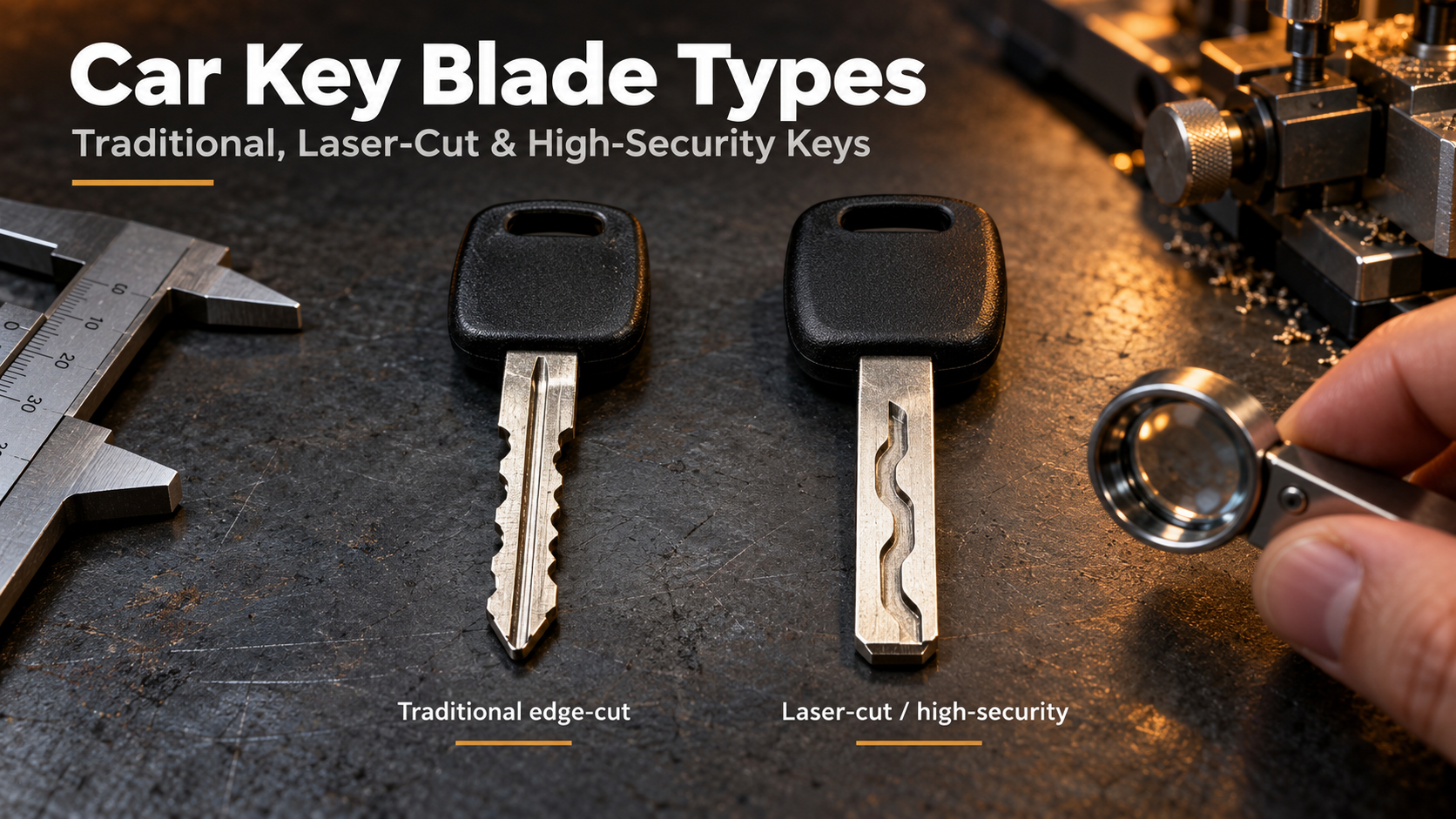
Try this: hold your car key up to the light and turn it edge-on. Do you see little teeth running along the edge, or a wavy groove carved into the flat side? That one look tells you more than you'd guess. The car key blade types you'll meet on the road come down to two shapes, and each one asks for different tools, different care, and a different price. Let's learn to read yours.
What Is a Car Key Blade?
The blade is the metal part of the key, the part that slides into the lock or ignition and does the old-fashioned job of turning it. Everything else, like the plastic head, the buttons, and the tiny chip inside, adds protection or convenience. Today's car key blades are shaped with a pattern of ridges or grooves that matches your lock, which is why two keys can look the same from the front and still behave very differently. Get the pattern wrong by a hair and the key simply won't turn. So the real question is which pattern family yours belongs to.
Common Types of Car Key Blades
There are two main families, and the names overlap a little, so don't worry if you've seen them used loosely. Traditional car keys have teeth along the edges, much like a house key. The other family has a groove cut into the face, and most keys in it are called high-security. Here's how each one looks and feels.
Traditional Edge-Cut Key Blades
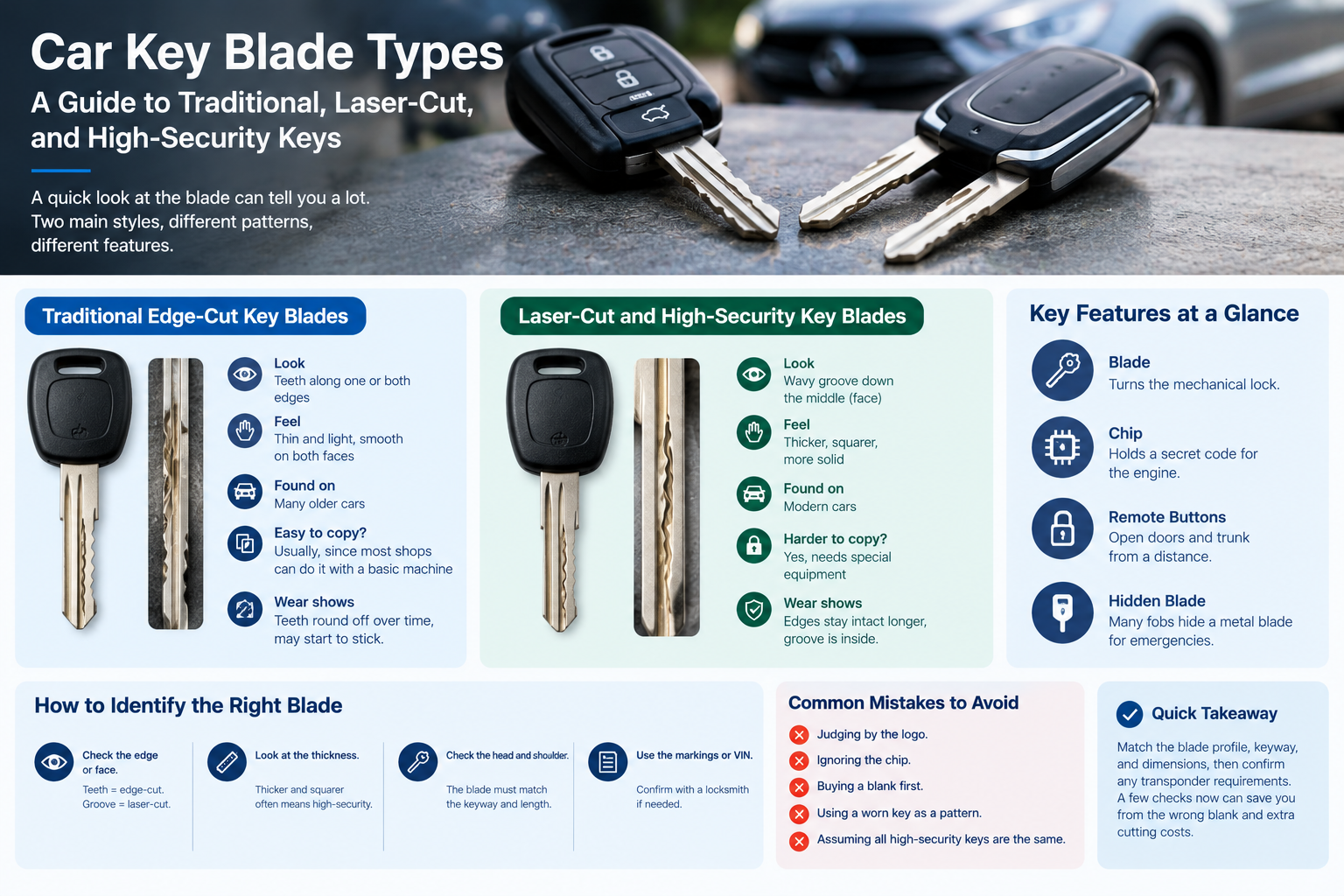
- Look: a flat blade with teeth along one or both edges
- Feel: thin and light, smooth on both faces
- Found on: many older cars
- Easy to copy? Usually, since most shops with a basic cutting machine can do it
- Wear shows: after years of use the teeth round off, and the key may start to stick in the lock
If a chip is hidden in the head, that's a separate step from the blade.
Laser-Cut and High-Security Key Blades
Now flip to the other family. Laser cut car keys look different at first glance: the blade is usually thicker, the edges are smooth, and a wavy channel runs down the middle of the flat face. Some people call them sidewinder keys for that reason. Here's a fun twist: the name suggests a laser beam, but the groove is usually made by a small cutting machine that follows a path, not by an actual laser. Because the groove sits inside the blade instead of along its edge, the key has a squarer, sturdier feel in your hand. Keep that picture in mind, because it's the easiest way to sort keys later.
How Car Key Blades Work With Modern Key Systems
A modern key isn't one part, it's a small team, and each member has its own job:
- The blade turns the mechanical lock, the same job keys have done for a century.
- The chip inside the head holds a secret code the car checks before it lets the engine run. A blade that fits is not enough if the chip isn't recognized.
- The remote buttons open doors and the trunk from a distance, and they're a separate circuit again.
- Hands-free fobs often hide a small blade inside the case as a backup for a dead battery.
A separate guide covers how smart and proximity keys differ.
How to Identify the Right Car Key Blade
You can sort a key at home in about a minute, and a little looking now saves a lot of hassle later. Start with the blank, the uncut piece of metal a key is shaped from. The key blank types you'll meet match the two families above, so your first job is simply to decide which family you hold.
Compare the Blade Design and Key Blank
Hold it up and run through these cues:
Cue | What to look at | What it tells you |
Edge-on view | Teeth along the edge, or a groove down the face | Teeth point to an edge-cut blade, a groove points to a laser-cut one |
Thickness | Set the key beside a spare | A noticeably thicker, squarer blade often points to high-security |
Head and shoulder | Where the blade meets the head | A blade that's a bit too long or short here won't sit right |
Tip shape | Pointed, rounded or angled | Easy to overlook, and easy to mismatch |
Both faces | Turn the key over | Some blades are cut on both sides |
Check Vehicle Compatibility
Looking right is only half the job. Matching car key blade types to your car also depends on the year, make and model, because one blade shape can show up on several models and be cut differently for each. Look for numbers or letters stamped on the head or blade and write them down. If the original is gone, your VIN lets a locksmith or parts seller confirm the exact blade. The earlier guide on matching a key to your car covers those details, so there's no need to repeat the whole process here.
What Makes High-Security Key Blades Different?
High-security isn't about looks. It's about what changes for you as an owner:
- Harder to copy? Yes. The groove can't be made on a basic edge-cutting machine, so many shops can't duplicate it.
- Costlier? Usually, because the blank and the cutting machine both cost more.
- Who can cut one? A locksmith or shop with the right equipment, which is why the nearest hardware store often says no.
- Does it last longer? Often, since the groove sits inside the blade and the edges wear less.
How to Choose the Right Automotive Key Blank
Once you know your family, the choice gets easier. Match your situation to the answer:
- If your key has teeth on the edge, an edge-cut blank in the right style is your match, and it's usually the budget-friendly route.
- If your key has a groove down the face, you need a laser-cut blank and a locksmith with the right cutter to shape it.
- If your key has a chip or buttons, remember that plain automotive key blanks are only the metal, and chips and remotes come separately or built in. Ask which one you're getting.
- If you plan to cut it yourself, buy a blank only if you have the tools. Otherwise, go for pre-cut or hand it to a locksmith.
- If you're unsure which style your car takes, use your VIN before ordering, not after.
Common Mistakes When Choosing a Car Key Blade
- Judging by the logo. A familiar brand on the head says nothing about the blade, so you can end up with a key that looks right and won't turn.
- Assuming all high-security keys are the same. Several shapes exist, so a groove alone doesn't tell you which blank fits.
- Forgetting the chip. A perfectly cut blade can open the door and still fail to start the car if the chip isn't set up.
- Buying a blank first and deciding later. You can end up holding a blank that no shop nearby can cut.
- Using a worn key as the pattern. Rounded teeth get passed on to the copy, so the new key sticks just like the old one.
Conclusion
Understanding car key blade types helps you choose a replacement that fits your vehicle. Match the blade profile, keyway, and dimensions, then confirm any transponder requirements and arrange professional cutting. Explore automotive key blanks at Transponder Island and compare the product specifications with your original key before ordering. A few careful checks can help you avoid the wrong blank, wasted cutting costs, and a key that will not work.
FAQs
What are the different types of car key blades?
Two main types: edge-cut keys with teeth on the sides, and laser-cut keys with a groove in the face. The second group is usually called high-security.
What is a traditional car key blade?
A flat blade with teeth along the edge, a lot like a house key. You'll see it mostly on older cars.
What is a laser-cut car key blade?
A thicker blade with a wavy groove down the middle of the face. That inner groove is why it's harder to copy.
How do I identify the correct car key blade for my vehicle?
Sort your key by shape first, then confirm with your VIN or the markings on it. A locksmith can read the rest.
How do I choose the right automotive key blank?
Pick the blade style first, then ask about the chip and buttons. If it's a groove style, plan on a locksmith.